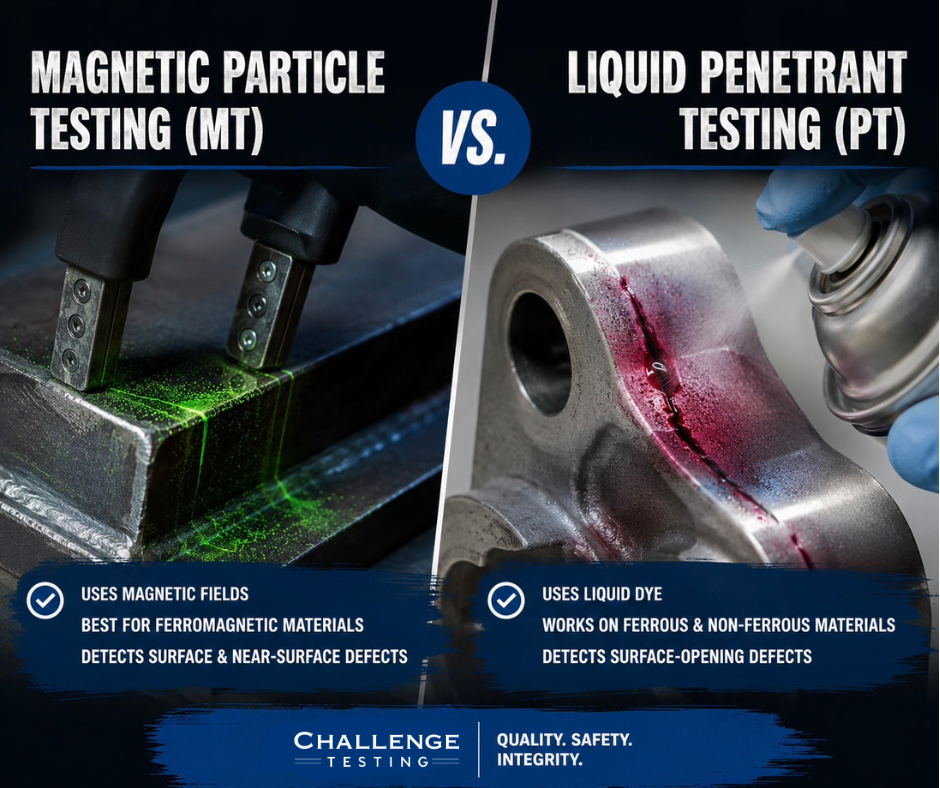
Non-destructive testing (NDT) plays an important role in identifying defects without damaging the component being inspected. Two commonly used surface inspection methods are Magnetic Particle Testing(MT) and Liquid Penetrant Testing (PT). While both methods are used to detect surface-breaking discontinuities, they work differently and are suited for different materials and applications.
Understanding the differences between MT and PT can help determine which inspection method is best fora specific project.
What Is Magnetic Particle Testing?
Magnetic Particle Testing, commonly referred to as MT, is an NDT method used to detect surface and near-surface discontinuities in ferromagnetic materials. These materials include iron, nickel, cobalt, and many types of steel.
During the inspection process, the component is magnetized using specialized equipment. If a crack or other discontinuity is present, it disrupts the magnetic field and creates a leakage field. Fine magnetic particles are then applied to the surface of the component. These particles are attracted to the area of magnetic leakage, creating a visible indication that can be evaluated by a qualified technician.
MT is commonly used to detect defects such as:
- Cracks
- Seams
- Laps
- Lack of fusion
- Other surface and near-surface discontinuities
One of the main advantages of Magnetic Particle Testing is its ability to detect very small discontinuities that may not be visible to the naked eye. Unlike PT, MT can also identify certain defects located slightly below the surface.
However, MT has one major limitation: it can only be used on ferromagnetic materials. Materials such as aluminum, copper, stainless steel that is not ferromagnetic, plastic, and many other nonmagnetic materials cannot be inspected using this method.
What Is Liquid Penetrant Testing?
Liquid Penetrant Testing, commonly referred to as PT, is another widely used NDT method for finding surface-breaking discontinuities. Unlike MT, PT does not require the material to be magnetic. It can be used on a wide range of nonporous materials, including many metals, plastics, ceramics, and other solid materials.
The PT process begins with thoroughly cleaning and preparing the surface of the component. A visible or fluorescent liquid penetrant is then applied to the surface and allowed time to enter any cracks or openings.
After the appropriate dwell time, the excess penetrant is removed from the surface. A developer is then applied, which helps draw the penetrant back out of any discontinuities. This creates a visible indication that can be evaluated by the technician.
PT is commonly used to detect:
- Surface cracks
- Porosity open to the surface
- Seams
- Laps
- Other surface-breaking discontinuities
One of the greatest advantages of Liquid Penetrant Testing is its versatility. It can be used on many different materials and components, making it useful across a wide range of industries.
The main limitation of PT is that it can only detect defects that are open to the surface. It cannot identify discontinuities hidden below the surface of a component. The surface must also be clean and nonporous for the inspection to be effective.
What Are the Main Differences Between MT and PT?
Although Magnetic Particle Testing and Liquid Penetrant Testing are both used to find discontinuities, there are several important differences between the two methods.
The biggest difference is the type of material each method can inspect. MT is limited to ferromagnetic materials, while PT can be used on a much wider range of nonporous materials.
Another important difference is the depth of the defects that can be detected. PT can only find discontinuities that are open to the surface. MT can detect both surface-breaking flaws and certain discontinuities located slightly below the surface.
The inspection process is also different. MT relies on a magnetic field and magnetic particles to reveal defects. PT uses a liquid penetrant and developer to make surface-breaking discontinuities visible.
Both methods require proper surface preparation and must be performed by qualified technicians who can correctly interpret the results.
Which NDT Method Is Right for Your Project?
Choosing between Magnetic Particle Testing and Liquid Penetrant Testing depends on several factors, including the material being inspected, the type of defect being evaluated, the component’s condition, and applicable codes or project specifications.
For ferromagnetic materials such as carbon steel, MT may be the preferred method, especially when both surface and slightly subsurface discontinuities are a concern. For nonmagnetic materials or projects where only surface-breaking flaws need to be identified, PT may be the better option.
In some situations, more than one NDT method may be used to provide a more complete evaluation. The appropriate inspection method should always be selected based on the specific requirements of the project.
The Importance of Choosing the Right NDT Method
Both Magnetic Particle Testing and Liquid Penetrant Testing are valuable tools for identifying defects before they lead to larger problems. Detecting discontinuities early can help support quality control, reduce the risk of equipment failure, and verify that components meet applicable requirements.
The key difference comes down to the material being inspected and the type of defect being evaluated. MT is ideal for detecting surface and near-surface discontinuities in ferromagnetic materials, while PT is a versatile option for detecting surface-breaking flaws in many nonporous materials.
At Challenge Testing, our qualified NDT professionals provide inspection services to support industrial, structural, marine, fabrication, and other projects. By selecting the appropriate NDT method for each application, we help our clients identify potential issues and maintain the quality and integrity of critical components.
Contact Challenge Testing to learn more about our Magnetic Particle Testing, Liquid Penetrant Testing, and other non-destructive testing services.